



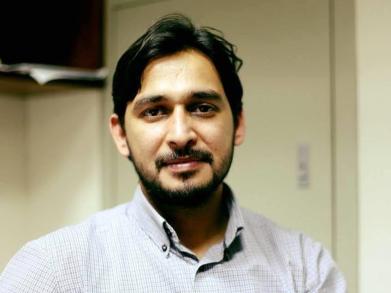
From late-night chai in the Communications Lab to developing the "brains" behind self-driving cars in Cambridge, Hamza Adnan's journey reflects the intellectual curiosity and interdisciplinary spirit that defines the Syed Babar Ali School of Science and Engineering (SBASSE).
A graduate of the Electrical Engineering programme at LUMS, Hamza is now working as a research engineer in Cambridge after pursuing graduate studies at Oxford. In this conversation with Madiha Rahman, Communications and Partnerships Lead at SBASSE, he reflects on the mentors, friendships, and questions that shaped his journey.
"Karachi prepared me for hostel life"
Madiha: Hamza, let's begin at the beginning. What first sparked your interest in science?
Hamza: I grew up in Karachi, which in many ways is a preview of hostel life - a melting pot of ethnicities, languages, and cultures from across Pakistan.
As a child, I was always fascinated by questions about how things work: how nature behaves, how societies organize themselves, how systems function. For a long time, I thought I would study physics. It seemed like the most philosophical and fundamental of sciences.
But there was also a part of me that wanted to build things with my hands. Electrical Engineering felt like perfect the balance - it allowed me to explore mathematics, physics, engineering, and computing all at the same time.
Another important factor was flexibility. I was always wary of the academic rigidity that exists in many university systems, where you choose a discipline at 17 and follow a fixed path for the rest of your degree. I wanted to experiment - attend a history lecture, explore theoretical physics, spend time in a chemistry lab. LUMS felt like the only place where that kind of intellectual freedom was possible.
Finding community during a pandemic
Madiha: You joined LUMS in 2020 - during the height of COVID-19. That must have been an unusual start to university life.
Hamza:
It definitely was. Only a small number of students with laboratory work were allowed on campus that year, so the community was very small.
But strangely enough, that year turned out to be one of the most meaningful periods of my life.
Against all odds, I ended up meeting people who would become incredibly important to me. That year I met my wife, some of my closest friends, and professors who shaped my intellectual and professional trajectory.
Looking back, those early months set the tone for the next four years: curiosity, mentorship, and a strong sense of community.
Mentors who pushed beyond the classroom
Madiha: Many SSE students talk about the mentorship they receive from faculty. Were there particular professors who influenced your path?
Hamza: Absolutely. Dr. Muhammad Tahir, Dr. Momin Uppal, and Dr. Zubair Khalid were incredibly influential in my journey. They were the first people who encouraged me to go beyond the classroom. Dr. Tahir would often give me additional academic material to strengthen my foundations in areas I was curious about.
Eventually, they hired me as a research assistant in their research group. That experience introduced me to something I hadn't fully appreciated before - the joy of research that is both socially relevant and technically rigorous. It was during that time that I realized graduate school was the path I wanted to pursue.
Chai, chaos, and the Communications Lab
Madiha: What about the student community at SSE? What do you remember most about those years?
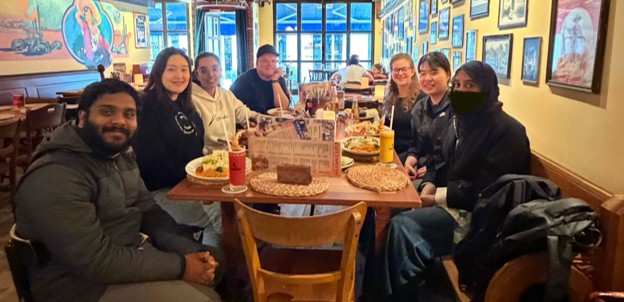
Hamza: My peers were some of the most supportive and intellectually stimulating people I've ever met. There was never a dull conversation. Our curiosity constantly fed off one another's questions, and working on labs and projects together taught me what collaboration truly means.
And of course, there was our daily ritual: 5 pm Chai. No matter how intense things got, that break would remind us that we were all in it together.
One memory that really captures the spirit of those years was the night before our final SPROJ presentations. We stayed in the Communications Lab late into the night preparing together, running on Chai and coffee.
The stakes felt enormous, but the atmosphere was strangely calm - almost celebratory. It felt like the culmination of four years of shared effort and curiosity.
There were also some... less controlled experiments along the way. Let's just say we accidentally blew up a piece of high-power equipment in the lab once. I might tell that story again when everyone involved becomes a famous scientist.
Learning that consistency beats perfection
Madiha: Senior year often brings a different kind of pressure. What challenges did you face?
Hamza: Senior year felt different because the decisions suddenly felt very consequential.
Choosing a project direction, deciding on courses, applying to graduate schools - each decision felt like buying a one-way ticket to a particular future.
I struggled a bit with procrastination during that time. But eventually I realized something important: consistency beats perfection.
The habits that brought us this far - showing up, working steadily, staying curious - matter far more than trying to plan every possible outcome.
It's something I'm still learning.
From LUMS to Oxford - and beyond
Madiha: Your academic journey eventually led you to Oxford. How did that experience unfold?
Hamza: Getting onto the programme and receiving a scholarship was a blessing. Like most people applying to competitive programmes, I received a long list of rejections along the way. At the time, it felt discouraging - I even thought some of those institutions might have been better opportunities. But that's simply the reality of competitive applications.
Interestingly, I didn't have much time to prepare for the transition because my scholarship decision came quite late. I mostly relied on excitement and momentum to carry me through those first months. And honestly, excitement can be a rare resource in graduate school.
Building the brains of self-driving cars
Madiha: You're now working as a research engineer in Cambridge. What does your work involve?
Hamza:
I'm working at a startup where we're developing the "brains" behind self-driving cars.
The work constantly reminds me how extraordinary human cognition is. We take our perception and decision-making abilities for granted, but replicating even small parts of that in machines is incredibly difficult.
During my final interview for this job, one of the senior scientists - who also supervises PhD students at Oxford - asked me about my education at LUMS. He was genuinely surprised by the strength of the mathematical foundations I had developed.
That moment made me appreciate something even more clearly: the emphasis SSE places on fundamentals is incredibly valuable. Even without the most powerful computational resources, those foundations stay with you and continue to support you throughout your career.
Advice to SBASSE students
Madiha: Finally, what advice would you share with students currently at SBASSE?
Hamza: TEACH!
It's the best way to learn anything.
And whatever problem you're working on - academic or otherwise - learn to enjoy struggling with it. That process teaches you one of the most underrated skills a scientist or engineer can develop:
The ability to ask good questions.
And good questions open a lot of doors!