



From Smart Glasses to Smart Infrastructure
Four A* publications redefining privacy, sustainability, and intelligence at the systems level
Over the past six months, Dr. Naveed Anwar Bhatti, Assistant Professor of Computer Science (CS) at SBASSE, has published four papers in A*-ranked international venues, including SenSys, PerCom, CHI and WWW, with acceptance rates ranging from approximately 15 to 25%. As Dr. Hamad Alizai, Chair of the Department of CS, notes, “By any global standard, this is an exceptional research accomplishment by an early-career faculty researcher. […] This body of work places LUMS CS firmly on the global research map at the highest level.”
A particularly distinctive aspect of this work is that undergraduate (BS) students carried out the the core research across all four papers. As Dr. Naveed Bhatti explains, “Through courses such as Directed Research Projects and Directed Coursework, our undergraduate students are able to work closely with faculty on active research problems for course credit. This creates an ecosystem where students are exposed to real research questions early on, allowing them to contribute meaningfully to work competitive at leading international venues.” He is looking forward to his students presenting their papers at the upcoming conferences.
Together, these works address a unifying challenge at the heart of modern computing: how to design intelligent systems that are not only powerful, but also responsible, efficient, and sustainable.
Automating efficiency in batteryless IoT systems
The first of these papers, published at SenSys 2025, addresses one of the hardest problems in embedded systems: how to run useful computation on devices that have no batteries and no reliable power source. Batteryless IoT devices harvest small amounts of energy from their environment, such as light, vibration, or radio signals, but lose power frequently and unpredictably. To cope, these systems rely on intermittent computing, repeatedly saving and restoring program state, a process that consumes precious energy and limits what such devices can realistically do.
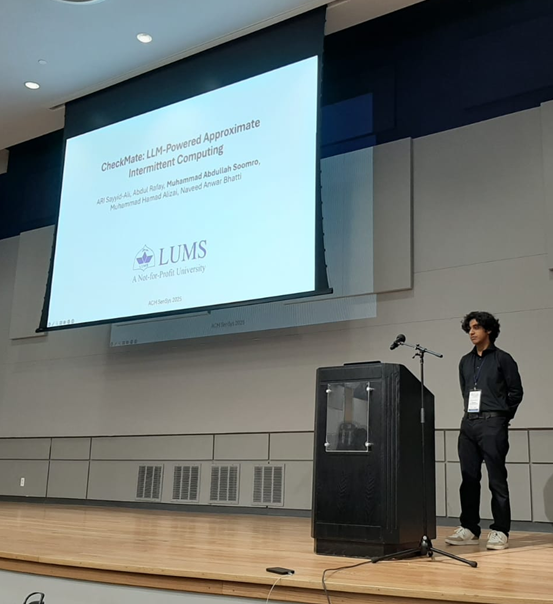
In “CheckMate: LLM-Powered Approximate Intermittent Computing,” Abdur-Rahman Ibrahim Sayyid-Ali, Abdul Rafay and Muhammad Abdullah Soomro, under the supervision of Drs. Hamad Alizai and Naveed Bhatti introduce CheckMate, a framework that fundamentally changes how efficiency is achieved in these systems.
Instead of focusing solely on reducing checkpointing overhead, CheckMate reduces the energy cost of computation itself by automatically introducing carefully controlled approximations—small, bounded reductions in accuracy that significantly lower energy use.
What makes CheckMate distinctive is that it automates a process that previously required deep expert knowledge. Using large language models (LLMs), the system identifies where approximation is safe and meaningful, generates candidate code modifications, and then rigorously validates them. Bayesian optimization is used to tune energy–accuracy trade-offs, ensuring that efficiency gains do not compromise correctness beyond user-defined limits.
Across six IoT applications, CheckMate reduces power cycles by up to 60 percent with minimal accuracy loss, enabling more useful work to be completed between power failures.
By making approximate intermittent computing scalable, reliable, and developer-friendly, this work opens the door to more capable batteryless systems supporting long-term, maintenance-free deployments in sensing, monitoring, and embedded intelligence.
Privacy by default for smart glasses
As camera-equipped smart glasses move rapidly into everyday use, they introduce new privacy risks—particularly for bystanders who may be recorded without notice or consent. In two complementary papers, Dr. Naveed and his students rethink how privacy should be embedded into wearable devices from the ground up.
In their PerCom 2026 paper, “Now You See Me, Now You Don’t: Consent-Driven Privacy for Smart Glasses”, Yahya Khawaja, Eman Nabeel, Sana Humayun, Eruj Javed, under the supervision of Drs. Hamad Alizai and Naveed Bhatti and in collaboration with Dr. Kathrina Krombholz (CISPA) introduce SITARA, a privacy-by-default architecture for smart glasses.
Instead of relying on warning lights or after-the-fact blurring, SITARA enforces on-device face blurring at the moment of capture, ensuring that raw footage of bystanders is never exposed. For wearers, the system offers synthetic face replacement, preserving social context without revealing identity. Crucially, any restoration of original footage is possible only through cryptographic consent from the bystander, preventing misuse even by malicious wearers. A working prototype demonstrates that such strong privacy guarantees are feasible on wearable-class hardware, with manageable energy and storage costs.
Building on this systems work, the CHI 2026 paper, “See Me If You Can: A Multi-Layer Protocol for Bystander Privacy with Consent-Based Restoration,” by Yahya Khawaja, Shirin Rehman, in collaboration with Dr. Kathina Krombholz and her PhD students Divyanshu Bhardwaj, Alexander Ponticello, under the supervision of Dr Hamad and Naveed, investigate how such privacy mechanisms are perceived by real users.
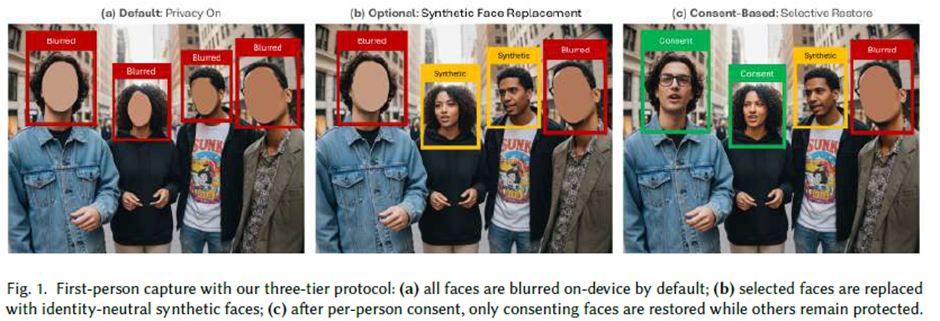
Through qualitative interviews with both smart-glass wearers and bystanders, the study reveals a clear tension: bystanders strongly support mandatory opt-in privacy protections, while wearers recognize their importance but desire more context-aware flexibility. The findings highlight that consent is not merely a technical switch, but a social negotiation—one that technology can help mediate if designed thoughtfully.
Measuring the sustainability of AI-powered search
Beyond wearables, Dr. Naveed’s research also examines the broader infrastructure impacts of modern AI systems. In a WWW 2026 paper, “Are LLM Web Search Engines Sustainable? A Web-Measurement Study of Real-Time Fetching”, his students, Abdur-Rehman Ibrahim Sayyid-Ali and Daanish Uddin Khan, present the first large-scale measurement study of how LLM-based answer engines interact with the open web.
Unlike traditional search engines that rely on cached indices, many LLM-based systems fetch web pages in real time for every query.
By instrumenting commercial systems such as ChatGPT and Claude across 1,000 queries, the study shows that these engines function as meta-search layers, repeatedly fetching top-ranked pages with minimal reuse. This design leads to significant redundant network traffic, shifting infrastructure costs onto publishers—particularly smaller websites. The paper argues that sustainability must become a first-class design goal for AI-powered search and proposes concrete solutions such as shared caching, transparent retrieval standards, and publisher controls.
A shared vision
Across wearables, web infrastructure, and embedded systems, these four papers share a common vision: advanced computing systems must be designed with responsibility, efficiency, and human impact at their core. Together, they position LUMS at the forefront of research shaping how emerging technologies are deployed safely, sustainably, and at scale.